PAGES

Thursday, March 15, 2012

Protectionism Vs. Free Trade in Achieving Economic Development

Protectionism is the economic policy of restraining trade between states through methods such as tariffs on imported goods, restrictive quotas, and a variety of other government regulations. It protects businesses and workers within a country by restricting or regulating trade with foreign nation.


It is a defensive measure, and it is usually politically motivated. It can often work, in the short run. However, in the long run it usually does the opposite of its intentions. It can make the country, and the industries it is trying to protect, less competitive on the global marketplace. 


Advantages of Protectionism:

  • If a country is trying to grow strong in a new industry, tariffs will protect it from foreign competitors. This allows companies in the new industry time to learn how to produce the good efficiently, and develop their own competitive advantages. 
  • Protectionism also temporarily creates jobs for domestic workers. As domestic companies are protected by tariffs, quotas or subsidies, they will hire locally. 

Disadvantages of Protectionism: 


  • In the long term, trade protectionism weakens the industry. Without competition, companies within the industry won't innovate and improve their products or services.  
  • Consumers will pay more for a lower quality product than they would get from foreign competitors. 
  •  Protectionism laws that reduce consumer spending power actually end up destroying jobs. 
  • It forces you to pay more taxes on imported goods. 


Free trade is a policy by which a government does not discriminate against imports or interfere with exports by applying tariffs (to imports) or subsidies (to exports). Under a free trade policy, prices emerge from supply and demand, and are the sole determinant ofresource allocation


'Free' trade differs from other forms of trade policy where the allocation of goods and services among trading countries are determined by price strategies that may differ from those which would emerge under deregulation.


Advantages of Free Trade:

  • Countries that specialize in creating commodities where they have the comparative advantage will increase their production, instead of focusing on products or industries in which other countries have the comparative advantage.  By increasing production, countries increase their efficiency. By specializing, countries better allocate their resources and purchase cheaper resources from other countries.
  • Free trade leads to a global market, consumers benefit from the competition and variety brought to the market. When other countries produce some items cheaper, the consumer purchases products for less.  It benefits consumers by increased innovations. As free trade expands, competition also expands. To stay competitive, companies must seek ways to create the comparative advantage. This leads to increased innovation that improves products.
  • Free trade may cause jobs in one particular industry to wind up overseas, jobs in the exporting and importing sides will increase. When productivity increases in importing and exporting, wages also tend to rise.
  • The countries involved in free trade experience rising living standards, increased real incomes and higher rates of economic growth. This is created by more competitive industries, increased productivity, efficiency and production levels. 

Disadvantages of free trade:

  • The removal of trade barriers, structural unemployment may occur in the short term. This can impact upon large numbers of workers, their families and local economies. Often it can be difficult for these workers to find employment in growth industries and government assistance is necessary. 
  • Increased domestic economic instability from international trade cycles, as economies become dependent on global markets.
  • Developing or new industries may find it difficult to become established in a competitive environment with no short-term protection policies by governments ("Infant Industry").


Protectionism is frequently criticized by economists as harming the people it is meant to help.
 Most economists instead support free trade. 

Monday, January 30, 2012

Personal Plan to achieve Financial Independence and Professional Competitiveness.


Every people has the same one dream, the dream all of us want to be. And that dream is to be financially success or stable in life. No one in this world wants to live in poverty. Everyone wants to be rich. And i am one of those dreamers who hopes someday i get to live in a mansion, drive my own car, and travel to any places in the world. 


But success cannot be reach without doing something to achieve that goal. You have to put lots of hardwork, dedication, and patience. I am thankful that i have loving parents who put me to a good school, give me clothes and food. And i know, these things that they are giving me will not always be forever. 

In return, i have to learn to someday live independently from them. Right now, i am studying. I am taking Accounting course. I know, this will be a good stepping stone in achieving my goals. I have to study my lessons to pass any quizzes or exams. I need to learn to use them when i have a job and also use them in everyday activity. Everyday i go to school to prepare myself in the next chapter of my life.
When i graduate, i want to have a job immediately and plan my life in achieving my goals. I know there is only a little chance that i will be financially success if i only land a job here in the country. So if i get a chance to go abroad, i will take it. I want to live my life to the fullest. I know its hard to leave your family . You feel "homesick" all the time. But its the truth, you cannot taste success without few sacrifices.
But first, i go to finish my studies. After i graduate, i find a stable job. Gather some experience. Then i go abroad.
I know not all workers going abroad are successful, but i've go to try and achieve my goals. If im not successful there, i know there are lots of opportunity to grab on.
Every steps i make, i just give the best out of me. Put to work all of the lessons i learned in life.

Sunday, December 18, 2011

"Pros and Cons of GDP as a Measure of Economic Development versus HUMAN DEVELOPMENT INDEX"

First, let's define Gross Domestic Product (GDP) and Human Development Index (HDI)


The GDP, or gross domestic product, is a number measuring the total value of all goods and services produced in a country in a given year. To determine the GDP, economists take the total consumer, government and investment spending, plus the value of exports, and subtract the value of imports. This number divided by the number of people in the country is the GDP per capita, or per person. Economic health in a capitalist society is currently assessed in terms of constant economic growth, primarily indicated by rises and drops in the GDP and GDP per capita.

Pros of GDP:

  • The first one is they have a lot of historical data to use and compare. If you have more historical data, you can achieve an accurate measurement of GDP. Not like the HDI which is just new.
  • Second is that many countries or almost of the countries in the world are using GDP as a measure of macroeconomic output. If many countries use GDP, you can compare their GDP's together and determine their output base on the data.
  • Third is that GDP is easy to calculate than HDI which makes it convenient and fast to determine the output of a particular country.
  • And last is that it is consistently measured across all country. Meaning, all the country are using GDP to achieve a uniform and fair results.
Cons of GDP:
  • First is it does not include domestic household products, or black market.
  • Second  does not consider the "real value" of money as it uses price*volume (yet prices change based on inflation, purchasing power of the money changes).
  • Third it does not consider how the wealth of a nation is distributed
  • Fourth, GDP is generally seen as an indicator of standard of living, but  social costs, environmental destruction, pollution and resources used up in the production process are not included in the calculations.
  • Lastly the calculation is an average of all economic activity based on the number of people in an entire country, it says nothing about regional economic differences within a country, nor does it give any indication of income disparity in the country. 


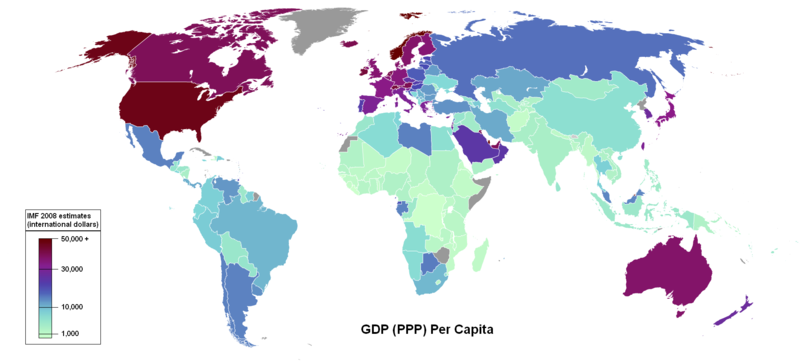
COUNTRIES ACCORDING TO THEIR GDP PER CAPITA (2008; IMF)


The Human Development Index (HDI) is a comparative measure of life expectancy, literacy, education and standards of living for countries worldwide.
It is used to distinguish whether the country is a developed, a developing or an under-developed country, and also to measure the impact of economic policies on quality of life. 
The Human Development Index (HDI) is an index used by the United Nations and various nongovernmental organizations (NGOs) to categorize and rank countries by their level of development. HDI scores can help prioritize a country's needs, as well as assist in helping organizations target problem areas such as education and longevity.

Pros of HDI:
  •  The HDI considers a lot of characteristics that measure a person´s living standards.  HDI is a more  reliable indicator as it takes into account social elements  health, education and income. Health focuses on longevity and the life expectancy of a country's residents at birth. Education measures adult literacy, as well as the percentage of residents enrolled in various levels of education. Finally, income measures the gross domestic product (GDP) of a country in U.S. dollars. Together, these factors show varying levels of development that can pinpoint specific areas that need work.
  • Ranks countries by level of "human development" and distinguish "very high human development", "high human development", "medium human development", and "low human development" countries.
  • Countries are ranked in terms of their HDI scores. A score of "1" is a perfect score, meaning a country is as developed as possible. A score of "0" is given to a country with no level of development.
  •  There are HDI for states, cities, villages, etc. by local organizations or companies. It is useful in determining output of a particular place or firms.
Cons of HDI:
  • It is new for some country. You cant determine the the output of for exampe last 20 years, unlike GDP which has lot of historical data.
  • HDI is not easy to calculate. It considers many factors on education, health etc.
  • The failure of the index to include any ecological considerations.
  • Does not look at enough factors to truly measure the level of happiness an individual feels in a certain country. To measure true happiness the formula must include physical, biological, mental, emotional, social, educational, economic, and cultural component.

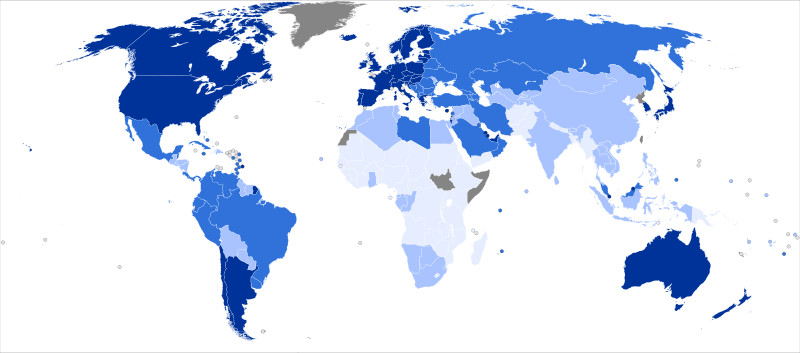
The United Nations Human Development Index (HDI) rankings for 2011


    Very High
   High
   Medium
   Low
   Data unavailable