First, let's define Gross Domestic Product (GDP) and Human Development Index (HDI)
The GDP, or gross domestic product, is a number measuring the total value of all goods and services produced in a country in a given year. To determine the GDP, economists take the total consumer, government and investment spending, plus the value of exports, and subtract the value of imports. This number divided by the number of people in the country is the GDP per capita, or per person. Economic health in a capitalist society is currently assessed in terms of constant economic growth, primarily indicated by rises and drops in the GDP and GDP per capita.
Pros of GDP:
- The first one is they have a lot of historical data to use and compare. If you have more historical data, you can achieve an accurate measurement of GDP. Not like the HDI which is just new.
- Second is that many countries or almost of the countries in the world are using GDP as a measure of macroeconomic output. If many countries use GDP, you can compare their GDP's together and determine their output base on the data.
- Third is that GDP is easy to calculate than HDI which makes it convenient and fast to determine the output of a particular country.
- And last is that it is consistently measured across all country. Meaning, all the country are using GDP to achieve a uniform and fair results.
Cons of GDP:
- First is it does not include domestic household products, or black market.
- Second does not consider the "real value" of money as it uses price*volume (yet prices change based on inflation, purchasing power of the money changes).
- Third it does not consider how the wealth of a nation is distributed
- Fourth, GDP is generally seen as an indicator of standard of living, but social costs, environmental destruction, pollution and resources used up in the production process are not included in the calculations.
- Lastly the calculation is an average of all economic activity based on the number of people in an entire country, it says nothing about regional economic differences within a country, nor does it give any indication of income disparity in the country.
COUNTRIES ACCORDING TO THEIR GDP PER CAPITA (2008; IMF)
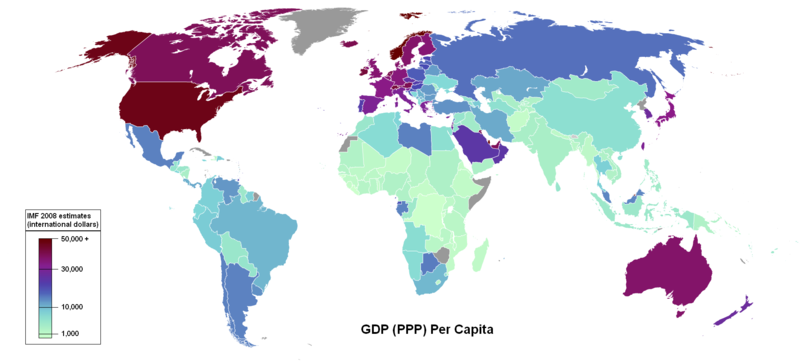
The Human Development Index (HDI) is a comparative measure of life expectancy, literacy, education and standards of living for countries worldwide.
It is used to distinguish whether the country is a developed, a developing or an under-developed country, and also to measure the impact of economic policies on quality of life.
The Human Development Index (HDI) is an index used by the United Nations and various nongovernmental organizations (NGOs) to categorize and rank countries by their level of development. HDI scores can help prioritize a country's needs, as well as assist in helping organizations target problem areas such as education and longevity.
Pros of HDI:
- The HDI considers a lot of characteristics that measure a person´s living standards. HDI is a more reliable indicator as it takes into account social elements health, education and income. Health focuses on longevity and the life expectancy of a country's residents at birth. Education measures adult literacy, as well as the percentage of residents enrolled in various levels of education. Finally, income measures the gross domestic product (GDP) of a country in U.S. dollars. Together, these factors show varying levels of development that can pinpoint specific areas that need work.
- Ranks countries by level of "human development" and distinguish "very high human development", "high human development", "medium human development", and "low human development" countries.
- Countries are ranked in terms of their HDI scores. A score of "1" is a perfect score, meaning a country is as developed as possible. A score of "0" is given to a country with no level of development.
- There are HDI for states, cities, villages, etc. by local organizations or companies. It is useful in determining output of a particular place or firms.
- It is new for some country. You cant determine the the output of for exampe last 20 years, unlike GDP which has lot of historical data.
- HDI is not easy to calculate. It considers many factors on education, health etc.
- The failure of the index to include any ecological considerations.
- Does not look at enough factors to truly measure the level of happiness an individual feels in a certain country. To measure true happiness the formula must include physical, biological, mental, emotional, social, educational, economic, and cultural component.
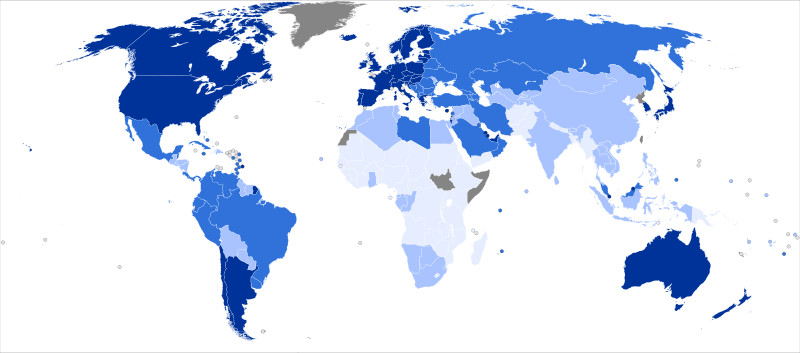 |
| The United Nations Human Development Index (HDI) rankings for 2011 |
Very High High Medium | Low Data unavailable |

No comments:
Post a Comment